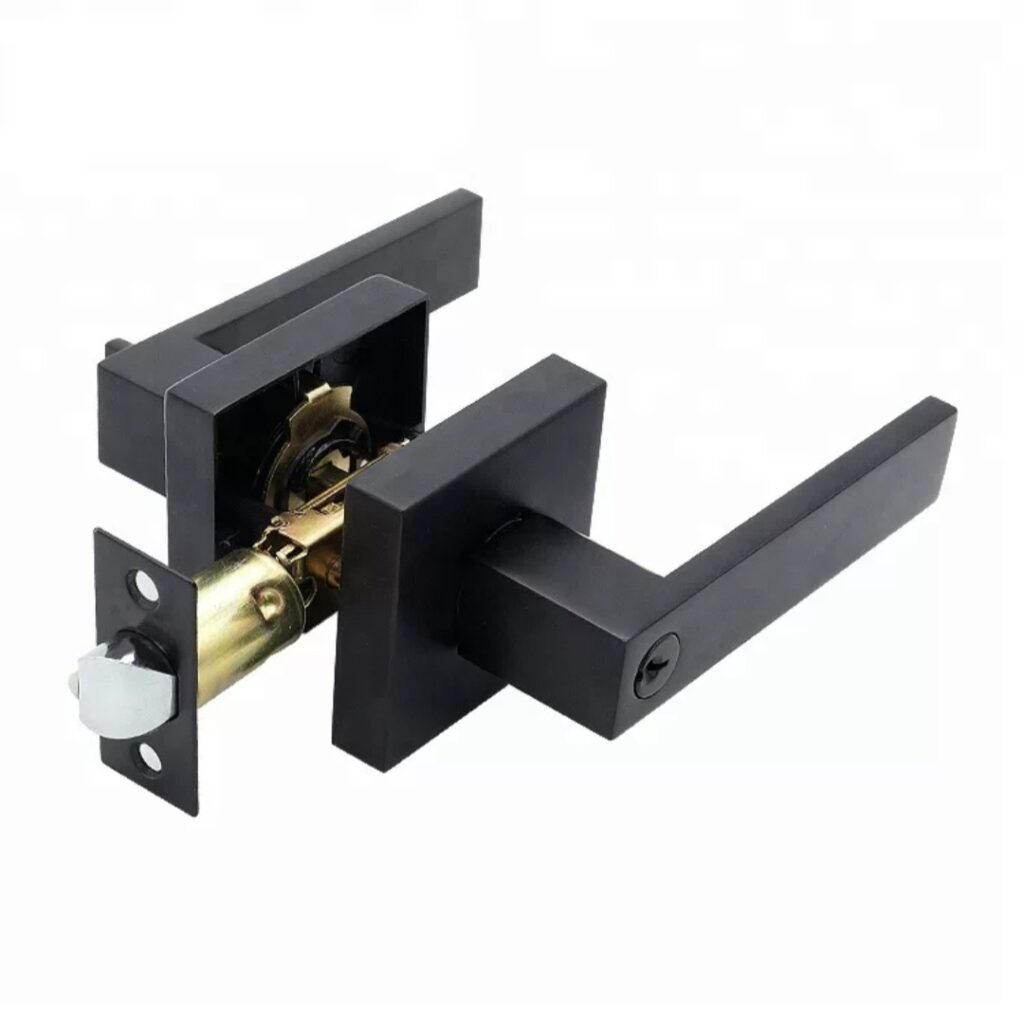
For overseas buyers sourcing door locks in bulk, product specifications usually focus on dimensions, material, finish, backset, cylinder type and packaging.
But there is another practical detail that can affect whether a lever lock fits the intended doors:
Door handing.
A buyer may order the correct model, finish and quantity, but still face installation problems if the handing of the lever lock does not match the application.
This is particularly important for building projects, replacement orders and bulk purchases where hundreds or thousands of locks may need to be installed.
Understanding door handing before placing an order can help B2B buyers avoid unnecessary replacements, installation delays and additional costs.
What Does Door Handing Mean?
Door handing describes the relationship between the door, hinges and lock handle when the door is opened.
In simple terms, a door may be described as:
●Left-handed
●Right-handed
●Left-hand reverse
●Right-hand reverse
●Reversible
The exact terminology can vary between manufacturers and markets, so buyers should not rely only on the words “left” or “right.”
The important question is:
How is the specific lock designed to work with the intended door?
Some lever locks are designed for a specific handing, while others have a reversible lever that can be adjusted for left- or right-hand applications.
This difference should be confirmed before a bulk order.
Why Handing Matters in Bulk Door Lock Orders
For a single replacement lock, a handing problem may be relatively easy to solve.
For a B2B order, the situation can be very different.
Imagine a buyer orders 1,000 tubular lever locks for an apartment project.
The product looks correct.
The finish is correct.
The dimensions are correct.
The packaging is correct.
However, when the installation team begins fitting the locks, they discover that part of the order is not suitable for the required door handing.
The problem is no longer just a product issue.
It can affect:
●Installation time
●Labor costs
●Project schedules
●Replacement arrangements
●Local inventory
●Transportation costs
●Communication between the buyer and installer
This is why handing should be treated as part of the product specification rather than as a minor installation detail.
How to Check Door Handing Before Ordering
Before confirming a lever lock for a bulk order, B2B buyers can check several practical points.
- Confirm the Door Application
First, understand where the lock will be installed.
Is it for:
●Residential doors?
●Hotel rooms?
●Apartment projects?
●Office buildings?
●Commercial properties?
●Replacement doors?
The application can affect which lock configuration is appropriate.For more information on choosing between tubular lever locks and tubular knob locks for different projects, see our guide to selecting the right lock type.
A replacement order may also need to match an existing installation rather than simply meet a general product specification.
- Check the Existing Door
For replacement projects, it is useful to inspect an existing door before placing the order.
Check the hinge position, opening direction and existing lock installation.
If possible, take clear photos of the door from both sides.
Photos can be especially useful when the buyer and supplier are located in different countries.
A simple photo can sometimes prevent a long series of messages trying to describe the installation verbally.
- Confirm Whether the Lever Is Reversible
This is one of the most important questions.
Some tubular lever locks can be used for both left- and right-hand doors by changing the lever orientation or adjusting the internal mechanism.
Other designs may have specific handing requirements.
Therefore, buyers should ask the supplier directly:
“Is this lever lock reversible for left- and right-hand doors?”
Do not assume that two visually similar lever locks have the same handing design.
The external appearance may be almost identical while the internal construction is different.
- Check the Installation Instructions
If the lock is intended for a large project, ask whether installation instructions are available.
The instructions should make it clear how the lever or latch configuration works with different door openings.
This is especially useful when the locks will be installed by a local contractor rather than by the original purchasing team.
Clear installation information can also reduce misunderstandings between the importer, distributor and installer.
- Confirm the Handing Requirement in the Order Specification
Once the handing requirement has been confirmed, record it in the order specification.
Do not leave an important installation requirement only in a WhatsApp conversation.
For example, the purchase specification can state whether the product is:
●Reversible
●Left-hand
●Right-hand
●Supplied according to a specific door application
If the order includes different configurations, list them separately.
This makes the requirement easier to check before production and before shipment.
Why Photos Can Be More Useful Than Descriptions
International B2B communication often involves different terminology.
A buyer may describe a door as “left opening,” while a supplier may interpret the same description differently depending on how the door is viewed.
This is one reason photos can be useful.
For a replacement or project order, buyers can send:
1.A photo of the complete door
2.A photo showing the hinge side
3.A photo of the existing lock
4.A photo of the lever from both sides
5.A photo of the door opening direction
The supplier can then review the application together with the product specification.
This does not replace technical confirmation, but it can make communication much clearer.
Handing Is Not the Same as Lock Function
Another point B2B buyers should understand is that door handing and lock function are not necessarily the same thing.
A passage lock, privacy lock or keyed entry lock can have different functions while still requiring a particular installation configuration.
Therefore, confirming only the lock function is not enough.
For example, a buyer may correctly specify:
Tubular Lever Lock – Keyed Entry
But the order may still require confirmation of the lever configuration and door application.For a broader checklist, buyers can also review our guide on checking door lock compatibility before placing a bulk order.
The more complete the specification, the less room there is for interpretation.
What Should B2B Buyers Ask the Supplier?
Before ordering a lever lock for a project or bulk order, buyers can ask a few simple questions:
Is the lever lock reversible?
Can it be installed on both left-hand and right-hand doors?
Does the latch or internal mechanism need to be adjusted?
Is the same model suitable for replacement applications?
Can you confirm the configuration based on our door photos?
These questions are simple, but they can prevent a product that is technically correct from becoming practically unsuitable for the project.
Why This Matters More for Overseas Buyers
For domestic purchases, a buyer may be able to return a product quickly if there is a handing problem.
International B2B orders are different.
A shipment may already have crossed borders.
The buyer may have paid international freight, import costs and local delivery charges.
The products may also have already been distributed to different project sites or warehouses.
That is why overseas buyers should try to identify installation-related requirements before production begins.
Handing is only one example.
The same principle applies to other product details that can affect installation.
A Practical Final Check Before Bulk Ordering
Before approving a tubular lever lock order, a buyer can use this simple checklist:
Product model: Confirm the exact model.
Lock function: Confirm passage, privacy, keyed entry or another required function.
Door application: Confirm the intended type of door.
Handing: Confirm left, right or reversible design.
Installation: Confirm whether any adjustment is required.
Photos: Provide door and existing lock photos when necessary.
Order specification: Record the confirmed requirement in writing.
This process does not need to be complicated.
The goal is simply to make sure that the lock being purchased matches the door on which it will actually be installed.
Final Thoughts
For B2B door hardware buyers, a good lock is not only about material, finish or appearance.
It also needs to work correctly in the actual installation environment.
Door handing is a small specification, but on a large order, small specifications can create large practical problems when they are misunderstood.
Before ordering tubular lever locks in bulk, take a few minutes to confirm the door application, opening direction and whether the lock is reversible.
A clear technical confirmation before production is usually much easier than solving an installation problem after the goods have already arrived.
For overseas buyers sourcing tubular lever locks, OEM orders or bulk door hardware, discussing these details with the manufacturer before production can make the purchasing process much more predictable.
Contact Shengzhao Hardware
If you are sourcing tubular lever locks, cylindrical locks or other door hardware for bulk orders, OEM projects or distribution, feel free to contact Shengzhao Hardware to discuss your requirements.
Website: www.shengzhao-hardware.com
WhatsApp / WeChat: +8613144755830
Email: service@shengzhao-hardware.com
We can discuss product specifications, quantities, packaging requirements and other details based on your project or market needs.