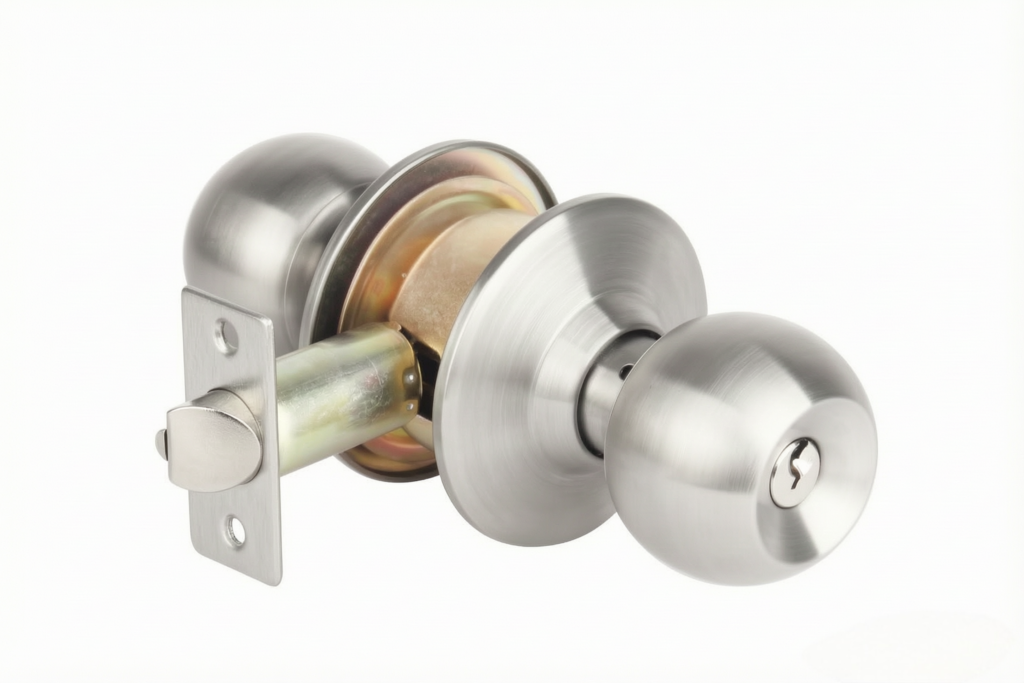
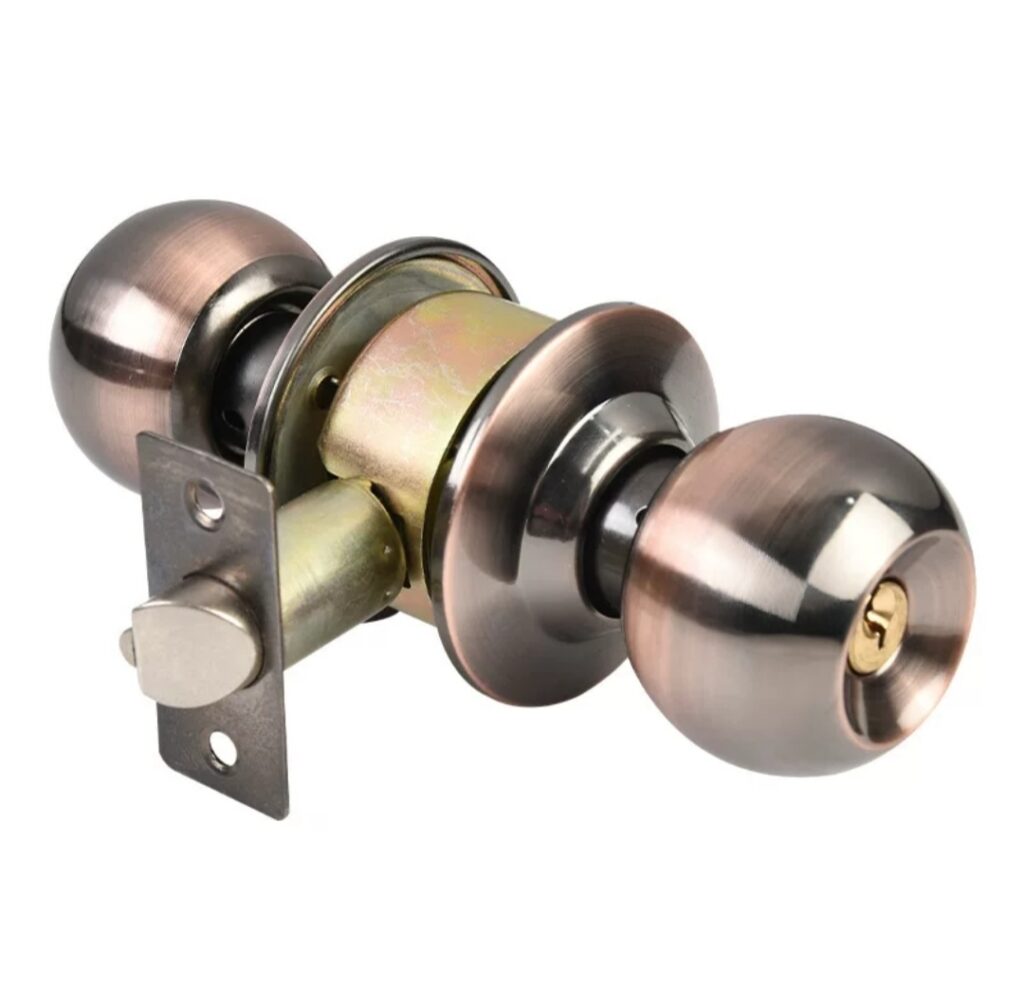
When overseas buyers source cylindrical knob locks, tubular lever locks, or other mechanical door locks in bulk, the visible parts usually receive most of the attention.
The finish.
The knob or lever design.
The cylinder.
The backset.
The packaging.
But one relatively small component can have a major effect on how the lock works after installation: the latch.
For wholesalers, distributors, and project buyers, understanding the difference between a standard spring latch and a deadlocking latch can help prevent specification mistakes before a bulk order is placed.
What Is a Door Lock Latch?
The latch is the part of the lockset that extends from the edge of the door into the strike area of the door frame.
When the door is closed, the latch enters the strike and holds the door in the closed position. When the knob or lever is operated, the latch retracts and allows the door to open.
In a typical tubular or cylindrical lockset, the latch is connected to the spindle and internal mechanism. This means that the latch is not simply an independent metal part. Its dimensions and movement need to work correctly with the rest of the lockset.This is also why buyers should check the overall door lock compatibility before confirming a bulk order.
For B2B buyers, this is important because a lock can look almost identical from the outside while using a different latch configuration inside.
That difference may not be obvious from product photos.
What Is a Standard Spring Latch?
A standard spring latch, also called a latch bolt, uses a spring-loaded bolt with a beveled front.
The beveled surface allows the latch to move inward when the door is pushed closed against the strike. Once the door reaches the closed position, the latch extends into the strike again.
This is a common arrangement for many interior and general-purpose mechanical door locks.
For buyers, the important point is that the latch must match the intended application and door preparation.
A supplier may offer several latch options for the same basic lock body, such as different backsets, faceplate configurations, or adjustable latch designs.
Therefore, asking only for the lock model may not always be enough when replacing an existing product.
What Is a Deadlocking Latch?
A deadlocking latch includes an additional feature designed to prevent the main latch bolt from being easily pushed back when the door is closed.
The small auxiliary component next to the main latch is commonly referred to as a guardbolt or deadlocking plunger.
When the door closes correctly against the strike, this mechanism is depressed and the main latch becomes deadlocked.
This is different from a standard spring latch.
The two products may look very similar when viewed from the outside, but the internal latch arrangement can be different.
For B2B buyers, this distinction can become important when a product is specified for a particular market, application, or customer requirement.
Why Does the Latch Type Matter in Bulk Purchasing?
For a single replacement lock, a buyer may be able to solve a latch mismatch during installation.
For a 500-piece, 2,000-piece, or 10,000-piece order, the consequences can be much larger.
A latch specification can affect:
●Door preparation
●Strike compatibility
●Installation method
●Door closing behavior
●Product function
●Replacement compatibility
●Assembly requirements
●Packaging and spare parts
●Final customer expectations
This is why experienced B2B buyers should not treat the latch as an insignificant accessory.
It is part of the actual lock specification.
- Check the Latch Type, Not Only the Lock Appearance
Two cylindrical locks may have almost the same knob, rose, finish, and overall appearance.
However, one may use a standard spring latch while another uses a deadlocking latch.
If the buyer’s existing market or project specification requires a particular latch design, choosing based only on photographs can create problems later.
When comparing suppliers, ask them to clearly identify the latch type in the quotation or specification sheet.
A simple line such as:
Latch: Standard Spring Latch
or
Latch: Deadlocking Latch
can make the specification much clearer.
- Confirm the Latch Dimensions
Latch type is only one part of the specification.
The buyer should also confirm the relevant dimensions.
Depending on the product, these may include:
●Backset
●Latch faceplate size
●Faceplate shape
●Latch body dimensions
●Door thickness range
●Bore preparation
●Strike dimensions
The exact dimensions required will depend on the lock design and the target market.
For this reason, buyers should avoid assuming that a latch from one supplier will automatically be interchangeable with another supplier’s lock simply because both products are described as “tubular” or “cylindrical.”
- Check How the Latch Works With the Strike
The latch and strike should be considered as a working pair.
A latch may be technically correct in its own dimensions but still create installation problems if the strike opening, position, or shape does not match the door frame preparation.
For bulk orders, it is therefore useful to check not only the latch itself but also the supplied strike.
A practical sample inspection should include:
1.Close the door normally.
2.Check whether the latch enters the strike smoothly.
3.Operate the lever or knob.
4.Confirm that the latch retracts completely.
5.Release the lever or knob.
6.Confirm that the latch returns fully.
7.Repeat the operation several times.
This simple door lock function check can reveal issues that are difficult to identify from product photographs.
- Do Not Assume Every Market Uses the Same Latch Configuration
One common mistake in international sourcing is assuming that one lock configuration will suit every market.
Different countries and distributors may have established preferences for:
●Backset
●Latch type
●Faceplate design
●Strike style
●Door thickness
●Keying
●Lock function
These market-specific requirements are part of the product specifications that buyers should confirm before placing an order.
A product that sells well in one market may therefore need a different configuration for another market.
For exporters and importers, this is one reason why the same basic lock design may have several product configurations.
- Ask for the Actual Latch Specification Before Production
Before approving a bulk order, buyers should request the latch details in writing.
A useful specification sheet can include:
Lock Model:
Latch Type:
Backset:
Faceplate:
Door Thickness:
Strike:
Function:
Keying:
Finish:
This does not need to be complicated.
The purpose is simply to make sure the buyer and supplier are talking about the same product.
This becomes especially important for repeat orders, OEM products, or orders containing several visually similar lock models.
Standard Latch vs. Deadlocking Latch: Which One Is Better?
There is no universal answer.
The better choice depends on the application, market requirements, existing door preparation, product specification, and customer’s expectations.
A standard spring latch may be suitable for many general-purpose applications.
A deadlocking latch may be preferred when the application or market specifically requires that type of latch mechanism.
The key point for B2B buyers is not to choose based on the assumption that one type is automatically better for every project.
Instead, specify the required function before production.
What B2B Buyers Should Ask Their Supplier
Before placing a bulk order for cylindrical or tubular door locks, buyers can ask the supplier five simple questions:
- What type of latch is included?
- What is the latch backset and overall specification?
- Is the latch adjustable or fixed?
- Which strike is supplied with the lock?
- Has the complete lockset been tested with the supplied latch and strike?
These questions are simple, but they can prevent misunderstandings between the buyer’s specification and the supplier’s standard configuration.
Final Thoughts
When sourcing door locks internationally, buyers often focus on the parts that are easiest to see.
But reliable product selection depends on more than appearance.
The latch is a small component, yet it connects the lock mechanism with the door and frame. Its type, dimensions, movement, and relationship with the strike can all affect the final installation.
For overseas B2B buyers, the safest approach is simple:
Do not specify only the lock appearance.
Specify the working components as well.
A clear latch specification before production can help wholesalers, distributors, and project buyers reduce installation problems, avoid unnecessary product changes, and maintain more consistent products across future orders.
For bulk and OEM door lock sourcing, clear specifications are often more valuable than simply choosing the lowest quotation.
Contact Shengzhao Hardware
Website: www.shengzhao-hardware.com
WhatsApp / WeChat: +8613144755830
Email: service@shengzhao-hardware.com